
What is Victory?
As the wars in Gaza, Ukraine, and across the Straight of Hormuz roll on...

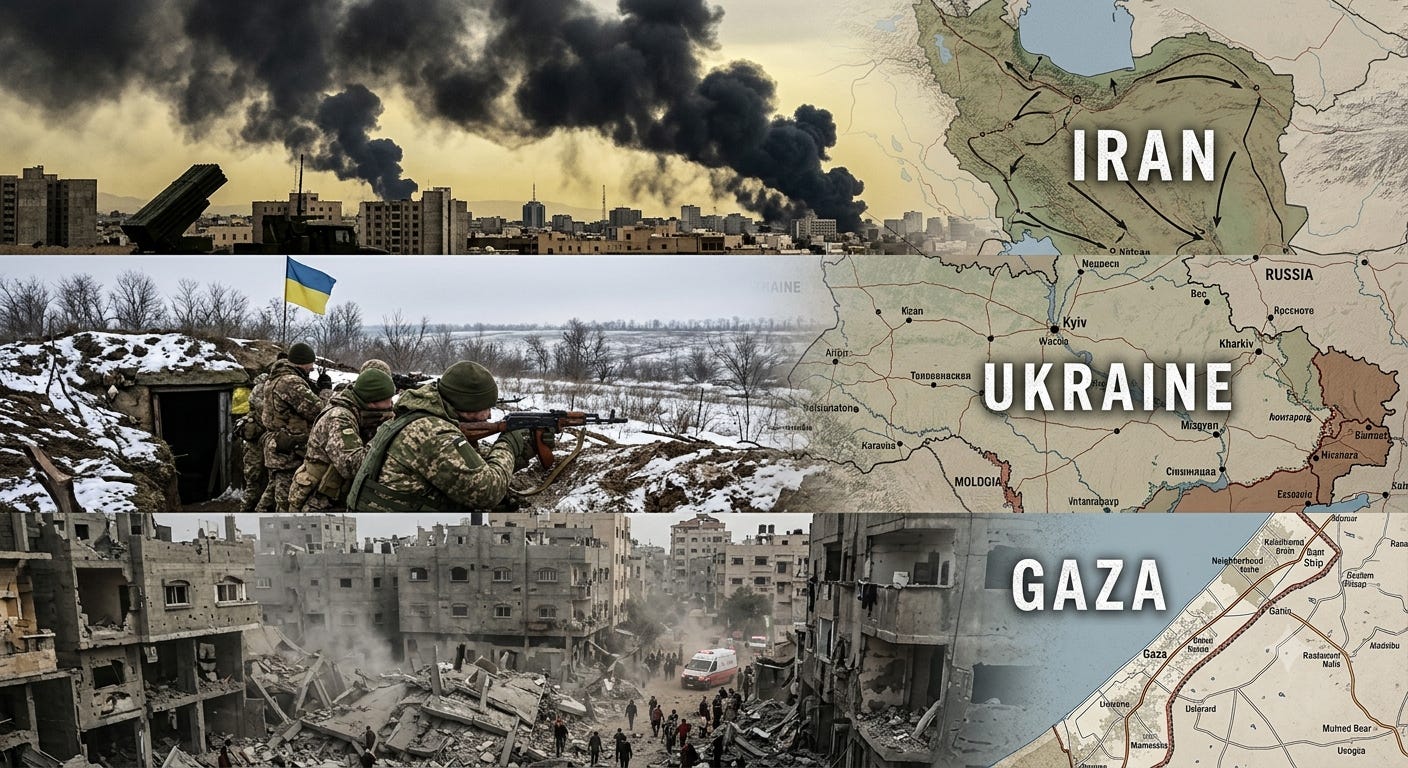
War, as it appears in the US mythology/movie framework, is vastly different from the lived experience in the rest of the world. Total war, as witnessed by Atlantic states and the Pacific states (yes, prior comments aside) is far from the memories of the US citizen, and our media reflects this.
War, as experienced in a video game, is short, exciting, explosive, and decisive. It’s entertaining. Movie versions are a mix of patriotic, valorous (or scandalous), and narrative driven.
Yet war, experienced by the people in the zones of conflict involve death, disability, starvation, rape, imprisonment, torture, suffering, deprivation, sickness, and simply hanging on. Humanitarian aid is not part of the equation. When survival is on the line, there is no boundary that cannot be crossed.
The present incarnation of the US has a hard time imagining giving up its way of life. For all the animosity of our present political diatribes within the US body politic, the US somehow still believes it’s the best - best at being whatever it is we have become, despite hating 25% to 50% of the other bits of the nation - virtually symmetrically.
What the US needs for “victory” is different than for what “adversaries” see as victory. When the US is fighting against “communism,” the Viet Cong was fighting for survival. The present Iran’s spoken slogans include death to the US. The US doesn’t have a symmetric response - it wants Iran to get back in line with the US led world order. It’s a policing action, really. “Please make oil and stop trying to change the nations around you.” “Be quiet and make money in the system that we manage.”
In English language foreign affairs journals, the actor that is trying to get out of current world order system is called revisionist or revanchist. It’s interesting to look at the issues that drive us to organized violence - and find that it can be reduced to a bureaucratic memo, so to speak.
Clausewitz, from On War, Vol 1.
“War is nothing but a continuation of politics with the admixture of other means.”
Cassus Belli - the reasons we tell our body politic vs. the real reasons we wage war.
As I consider the situations each civilization and their people find themselves - it is more and more clear to me how difficult it is to get to “world peace.” The goals of each nation/organization/people/individual are not harmonized, and discordance is the rule.
When a group finds the current order disagreeable, there are only a handful of general responses-
Accept it.
Overturn it.
Subvert it.
And so, each of the above conflict represents an attempt to change the status quo, and each party has different goals. Each adjacent stakeholder has different optimal exit conditions. Each has a different willingness to expend resources. Perhaps most striking is the difference between existential motivations and those without.
When loss results in the potential annihilation of your group, the motivation to continue to fight is enormous. Survival is victory. Outlasting your opponent’s will is sufficient.
Conversely, would be conquerors who see victory as more than a legislative/political goal - and moreover, existential to the group identity - have substantial more will to prosecute a costly war.
The international idea on how a war is prosecuted is also unfortunately unworkable. You put out a treatise on what is legal in war - and those guidelines become gameable. Existential conflicts demand total commitment, and nothing is off the table. We are watching that mismatch play out across theatres.
Vietnam/Korea/Afghanistan all showed that technology cannot solve the essential problem of rooting out a culture that is existentially committed to surviving whatever you throw at them. Short of full-scale elimination of the population, the current “rules of war” do not allow for any precise way to “win,” as the victory conditions are so different.
Presently, Gaza/Hormuz/Ukraine show the complexity of modeling asymmetric warfare.
Thoughts for the future:
I think Israel will continue grinding out Gaza and the West Bank over the next 50 years.
I think Iran will either get control of Hormuz, or there will need to be political will from the Arab states to align against Iran and force a regime change.
I think Russia will grind out Ukraine to a smaller entity over the next 10 years, because Europe does not see Ukraine as existential, whereas Russia sees Ukraine as existential.
What is Victory?
It depends on who you are, your values, and your context.
Sometimes, survival is enough.
Sometimes, it’s absolute annihilation of your opponent.
Sometimes, it’s sufficiently degrading your enemy.
Understanding your own and your enemies’ visions/goals is paramount in all conflict.